USSD Codes in Kenya — The Offline Power Tool Every Business Needs in 2026
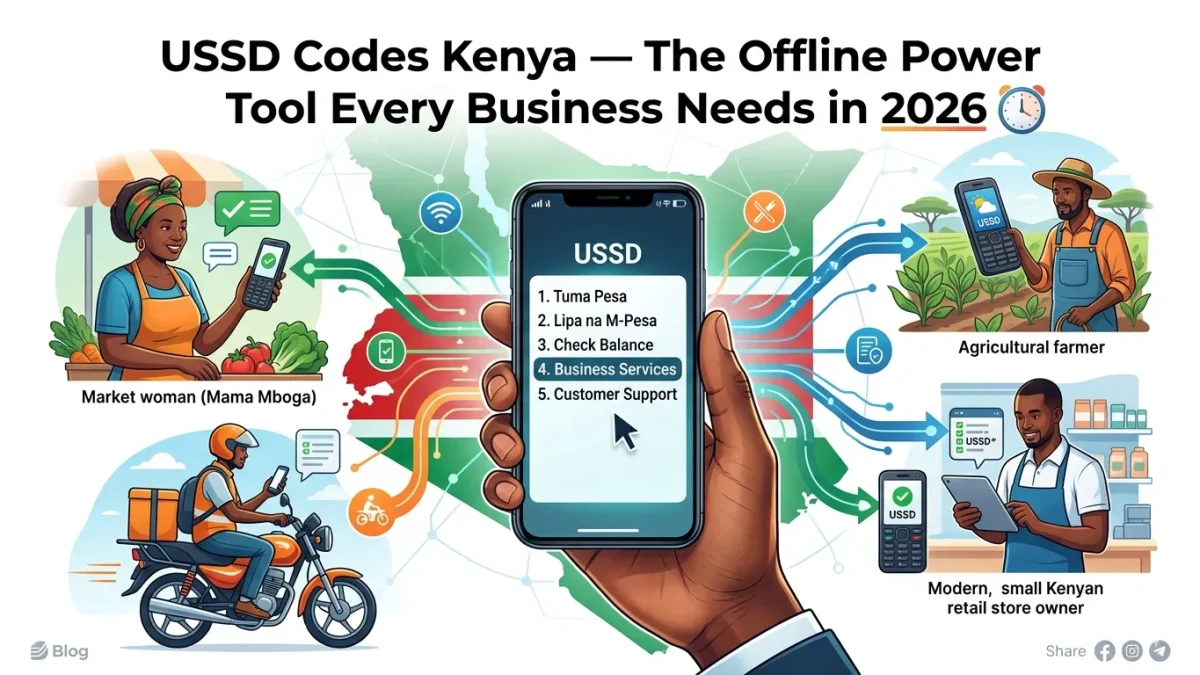
USSD (Unstructured Supplementary Service Data) is a real-time communication protocol built into every GSM mobile network. Celcom Africa provides USSD codes in Kenya with direct routes on Safaricom, Airtel, and Telkom networks — reaching 100% of mobile subscribers, including feature phone users with zero internet access — with session delivery in 2–5 seconds, 99.9% uptime, CAK-compliant infrastructure, and pricing built for Kenyan SMEs and enterprises alike.
Key Takeaways
- USSD codes work on every mobile phone in Kenya — no smartphone, no internet, no app required
- Celcom Africa delivers USSD sessions in 2–5 seconds across Safaricom, Airtel, and Telkom
- Dedicated and shared USSD shortcodes are available; dedicated codes deploy within 2–4 weeks
- USSD is CAK-regulated and fully compliant with Kenya’s Communications Authority licensing framework
- Over 10,000 Kenyan businesses use Celcom Africa for SMS, USSD, and multi-channel messaging
- USSD open rates and interaction rates far exceed email — sessions are initiated by the customer, meaning 100% active engagement
- Celcom Africa’s USSD API supports REST-based integration, making it deployable by in-house devs in under a day
Table of Contents
What Is a USSD Code and How Does It Work in Kenya?
USSD — Unstructured Supplementary Service Data — is a real-time communication protocol built into every GSM mobile network. When a Kenyan subscriber dials a shortcode like *384*1#, a live session is established between their phone and a business application in under five seconds, with no data connection required. The exchange is synchronous: the user sees a menu, selects an option, and the application responds — all in a single unbroken session.
Unlike SMS, which is a one-way push, or WhatsApp, which requires a smartphone and active internet, USSD is a two-way, real-time channel that works on a KSh 500 Kabambe feature phone just as reliably as on a flagship Android device. That characteristic is what makes USSD uniquely powerful in the Kenyan market, where the Communications Authority of Kenya reports mobile penetration above 130% but smartphone adoption is still heavily weighted toward urban centres.
The anatomy of a USSD session
A USSD session follows a precise, low-latency path: the subscriber dials the code → the mobile network (Safaricom, Airtel, or Telkom) routes the request → Celcom Africa’s USSD gateway receives and processes it → the business application responds via API → the gateway pushes the menu back to the subscriber’s screen. The entire round-trip completes in 2–5 seconds. Sessions are stateful, meaning the platform tracks where in a multi-level menu the user is at every step — enabling sophisticated self-service flows without a single byte of mobile data.
USSD vs SMS vs WhatsApp — which is right for your use case?
| Channel | Internet needed? | Works on feature phones? | Two-way real-time? | Best for |
| USSD | No | Yes | Yes | Self-service menus, balance checks, surveys, OTP |
| Bulk SMS | No | Yes | No (push only) | Alerts, promotions, reminders |
| WhatsApp API | Yes | No | Yes | Rich media, customer support, chatbots |
| Shortcode SMS | No | Yes | Limited (MO/MT) | Opt-ins, competitions, helplines |
For organisations serving upcountry Kenya — farmers in Kisumu, cooperative members in Nakuru and Eldoret, school parents in Kisii or Nyeri — USSD is the only channel that delivers interactive engagement at full national reach. Learn more about Celcom Africa’s Bulk SMS or WhatsApp Business API to build a complementary multi-channel strategy.
Why USSD Is the Most Powerful Offline Channel in Kenya
100% phone reach — feature phones included
Kenya’s mobile subscriber base is vast but heterogeneous. While Nairobi and Mombasa have high smartphone penetration, millions of subscribers in secondary and rural areas use entry-level feature phones. USSD is native to the GSM standard — it does not require a data plan, an app, or any configuration. Every subscriber on Safaricom, Airtel, and Telkom can access your USSD service the moment they know the code.
No internet required — critical for upcountry and rural markets
Mobile data connectivity remains patchy in many parts of Kenya. USSD bypasses the data layer entirely, operating over the signalling channel of the voice network. A SACCO in Thika offering loan applications via USSD instantly extends that service to members in peri-urban and rural areas who cannot reliably load a web page or receive a WhatsApp message.
Real-time two-way sessions in under 5 seconds
A USSD session is not a request-response pair — it is an active, stateful dialogue. The business controls the menu tree, the subscriber navigates it, and the application processes responses in real time. This makes USSD ideal for anything that would otherwise require a phone call or a branch visit: checking an account balance, applying for a microloan, completing a health survey, or topping up airtime.
“Since deploying our USSD loan application menu through Celcom Africa, our SACCO’s branch walk-ins for loan queries dropped by 40% within three months. Members in Nakuru and Eldoret can now self-serve 24/7.” — Celcom Africa client, financial services sector
Celcom Africa USSD Codes — Features and Pricing
Dedicated vs shared USSD shortcodes
Dedicated USSD codes are exclusively yours — no shared traffic, full branding, unrestricted menu depth. These are recommended for banks, SACCOs, fintechs, large NGOs, government agencies, and any organisation requiring a persistent, branded customer-facing service.
Shared USSD codes allocate a sub-menu on an existing Celcom-managed code, enabling smaller businesses and startups to deploy USSD functionality quickly and cost-effectively without waiting for a dedicated CAK allocation.
USSD code pricing in Kenya (2026)
| Code type | Monthly fee | Setup | Suitable for |
| Shared USSD code | From KES 3,000/month | KES 5,000 | SMEs, pilot projects |
| Dedicated USSD code | From KES 10,000/month | KES 20,000 | Enterprises, regulated industries |
| Session fees | KES 0.25–0.60 per session | — | Billed on consumption |
Pricing is indicative. Contact Celcom Africa for a tailored quote based on expected monthly session volume.
How long does it take to get a USSD code?
A shared USSD code can go live in 24–72 hours after application approval and API integration. A dedicated USSD shortcode requires allocation from the Communications Authority of Kenya and typically activates within 2–4 weeks. Celcom Africa manages the CAK application process on your behalf, simplifying a step that other providers leave entirely to the client.
How to Set Up a USSD Code with Celcom Africa (Step by Step)
Step 1 — Register and choose your code
Create a free account at celcomafrica.com. Select USSD from the product menu and indicate whether you need a shared or dedicated code. If dedicated, provide your business registration details for the CAK application — Celcom Africa handles submission.
Step 2 — Design your USSD menu flow
Map out your menu tree before touching the API. Define the root menu options, sub-menus for each branch, and terminal actions (send an SMS confirmation, trigger a payment, log a survey response, push data to your CRM). Celcom Africa’s team provides menu design consultation for enterprise clients.
Step 3 — Connect via Celcom USSD API
Celcom Africa exposes a REST API that your server calls to receive session requests and push menu responses. The handshake is simple:
# Sample cURL — receive a USSD request and respond with a menu
curl -X POST https://api.celcomafrica.com/v1/ussd/session \
-H “Authorization: Bearer YOUR_API_KEY” \
-H “Content-Type: application/json” \
-d ‘{
“sessionId”: “ATUid_abc123”,
“phoneNumber”: “+254712345678”,
“networkCode”: “63902”,
“input”: “1”,
“serviceCode”: “*384*1#”
}’
# Your server responds:
{
“response”: “CON Welcome to Celcom Demo\n1. Check balance\n2. Apply for loan\n3. Contact support”
}
# Use “CON” to continue session (show next menu)
# Use “END” to terminate session (final response)
The CON / END prefix pattern is standard across all Kenyan USSD providers. Sessions time out after 180 seconds of inactivity — design your menus to be navigable within 3–4 steps.
Step 4 — Go live on Safaricom, Airtel, and Telkom
Once your API endpoint passes Celcom Africa’s QA testing, the code is provisioned across all three networks simultaneously. You receive a dashboard to monitor session volumes, completion rates, drop-off points, and real-time errors.
USSD Use Cases for Kenyan Businesses
Banks and SACCOs
Kenya’s banking sector was built on USSD. M-Pesa itself originated as a USSD-based service. Today, banks and SACCOs across Nairobi, Kisumu, Mombasa, and secondary towns use USSD to deliver account balance inquiries, mini-statements, interbank transfers, loan applications, and PIN changes without requiring customers to visit a branch or use a smartphone app. For SACCOs in particular — where many members are semi-urban or rural — USSD is the primary digital touchpoint. GSMA Intelligence data confirms that mobile money in Sub-Saharan Africa continues to be dominated by USSD-based sessions.
NGOs and healthcare providers
International and local NGOs operating in Kenya — covering health, agriculture, education, and humanitarian response — use USSD to collect real-time field data, run beneficiary surveys, and push notifications to project participants who lack smartphone access. Healthcare providers use USSD for appointment booking, medication adherence reminders triggered via session opt-in, and community health worker reporting.
Schools and government agencies
County governments and national agencies increasingly use USSD to deliver citizen-facing services: tax payment confirmation, permit status, social protection payment notifications, and public health alerts. Schools use USSD for fee balance inquiries and parent engagement in areas where WhatsApp reach is low.
E-commerce, logistics, and retail
E-commerce operators and logistics companies in Nairobi, Mombasa, and Eldoret use USSD to allow customers to track orders, confirm delivery, request callbacks, and complete cash-on-delivery confirmations — all without a data connection. For last-mile delivery operations serving Kenya’s peri-urban areas, USSD is often the only reliable customer communication tool.
Celcom Africa vs Competitors — USSD Providers in Kenya
| Feature | Celcom Africa | Africa’s Talking | Twilio | Infobip |
| Dedicated USSD code | ✅ Yes | ✅ Yes | ❌ No Kenya USSD | ❌ No Kenya USSD |
| Shared USSD code | ✅ Yes | ❌ No | ❌ No | ❌ No |
| CAK application support | ✅ Managed | ❌ Self-service | ❌ N/A | ❌ N/A |
| Networks covered | Safaricom + Airtel + Telkom | Safaricom + Airtel | — | — |
| Session pricing | KES 0.25–0.60 | KES 0.40–0.80 | ~KES 20–30 eq. | Enterprise quote |
| Local 24/7 support | ✅ Yes | ❌ Developer-only | ❌ No Kenya team | ❌ No local support |
| Free trial | ✅ 50 free SMS + demo | ❌ No | ❌ No | ❌ No |
| SME-friendly onboarding | ✅ Yes | ❌ Developer focus | ❌ USD pricing | ❌ Enterprise only |
Celcom Africa is the only provider in Kenya that combines managed CAK application support, shared USSD codes for SMEs, competitive per-session pricing, and dedicated local support — making it the practical choice whether you are a startup in Nairobi’s tech ecosystem or an enterprise bank operating nationally. Africa’s Talking serves developers well but offers no hand-holding for business users. Twilio and Infobip have no meaningful USSD presence in Kenya at all.
Developer Guide — Celcom USSD API Integration
Celcom Africa’s USSD API is REST-based with JSON payloads, requiring no proprietary SDK. The workflow follows the Africa’s Talking-compatible USSD session model, making migration straightforward for developers who have previously worked with that platform.
Key API concepts:
- sessionId — a unique identifier for each live USSD session
- phoneNumber — the MSISDN of the dialling subscriber (E.164 format)
- networkCode — the MNO identifier (63902 = Safaricom, 63901 = Airtel, 63903 = Telkom)
- serviceCode — the USSD shortcode the subscriber dialled
- input — the subscriber’s menu selection at each step
Python integration example:
from flask import Flask, request, jsonify
app = Flask(__name__)
@app.route(‘/ussd’, methods=[‘POST’])
def ussd_handler():
session_id = request.form.get(‘sessionId’)
phone_number = request.form.get(‘phoneNumber’)
text = request.form.get(‘input’, ”)
# Root menu (first dial — input is empty)
if text == ”:
response = “CON Welcome to Celcom Demo Service\n”
response += “1. Check account balance\n”
response += “2. Make a payment.”
response += “3. Contact support”
elif text == ‘1’:
# In production: query your database here
response = “END Your account balance is KES 4,250.”
elif text == ‘2’:
response = “CON Enter amount to pay (KES):”
elif text.startswith(‘2*’):
amount = text.split(‘*’)[1]
response = f”END Payment of KES {amount} initiated. You will receive an SMS confirmation.”
elif text == ‘3’:
response = “END Call us on +(254) 703 72 72 72 or email enquiries@celcomafrica.com”
else:
response = “END Invalid option. Please try again.”
return response, 200, {‘Content-Type’: ‘text/plain’}
if __name__ == ‘__main__’:
app.run(debug=True)
Full API documentation, sandbox environment access, and webhook configuration guides are available via your Celcom Africa dashboard after registration.
Ready to Deploy Your USSD Code in Kenya?
Join 10,000+ Kenyan businesses — from Nairobi fintechs and Mombasa logistics operators to upcountry SACCOs and national NGOs — that trust Celcom Africa for reliable, affordable USSD, SMS, WhatsApp, and multi-channel communication infrastructure.
CONTACT CELCOM AFRICA NOW & GET STARTED.
Frequently Asked Questions About USSD Codes in Kenya
What is a USSD code and how does it work in Kenya?
A USSD code is a short dialling sequence (e.g., *384*1#) that triggers a real-time interactive menu session on any mobile phone, without internet. When a subscriber dials, the request travels via Safaricom, Airtel, or Telkom to a USSD gateway (like Celcom Africa’s platform), which routes it to your business application. Your app responds with a menu and the session continues until completed or the user exits.
How much does a USSD code cost in Kenya?
Shared USSD codes start from approximately KES 3,000 per month with a KES 5,000 setup fee. Dedicated USSD shortcodes start from KES 10,000 per month. Session fees range from KES 0.25–0.60 per session, depending on volume and network. Celcom Africa offers transparent pricing with no hidden fees — contact the team for a volume-based quote.
How long does it take to get a USSD shortcode in Kenya?
A shared USSD code can be active within 24–72 hours of setup. A dedicated shortcode requiring a Communications Authority of Kenya (CAK) allocation typically takes 2–4 weeks. Celcom Africa manages the CAK application process, significantly reducing the administrative burden on businesses.
Does USSD work without internet in Kenya?
Yes. USSD operates entirely over the GSM signalling layer — the same infrastructure that handles voice calls. No mobile data plan, no Wi-Fi, and no smartphone is required. This makes USSD the most inclusive digital engagement channel in Kenya, reaching 100% of registered mobile subscribers regardless of phone type or data access.
What networks does Celcom Africa’s USSD service support?
Celcom Africa’s USSD platform has direct routes on all three major Kenyan networks: Safaricom, Airtel Kenya, and Telkom Kenya. Sessions are routed natively on each network, ensuring consistent delivery speed and reliability across the country — from Nairobi CBD to rural Kisii and remote parts of northern Kenya.
Can I integrate USSD with my existing system or database?
Yes. Celcom Africa provides a REST API with JSON payloads that connects your USSD menu to any backend system — databases, CRMs, payment gateways, ERPs, or custom applications. The API is compatible with all major languages (Python, PHP, Node.js, Java) and includes sandbox access for testing before go-live.
Who regulates USSD codes in Kenya?
USSD shortcodes in Kenya are regulated by the Communications Authority of Kenya (CAK) under the Kenya Information and Communications Act. All dedicated USSD codes require CAK approval. Celcom Africa is a CAK-compliant provider and handles the regulatory application process on behalf of enterprise and SME clients.
USSD ni nini na inafanyaje kazi Kenya?
USSD (Unstructured Supplementary Service Data) ni huduma ya mawasiliano ya wakati halisi inayofanya kazi kwenye simu yoyote ya mkononi bila kuhitaji intaneti. Mtumiaji anaandika nambari kama *384*1#, na kikao cha maingiliano kinaanzishwa mara moja kati ya simu yake na programu ya biashara kupitia mtandao wa Safaricom, Airtel, au Telkom. Celcom Africa inatoa huduma hii kwa biashara zote za Kenya.